
Drums Aloud Instruments/Drums
Drums Aloud have used some of the grant money to purchase the following instruments(for use in regular classes, but also to school and community groups in Birmingham and the Black Country):- 7 dunduns (1 x dundunba, 3 x sangban & 3 x kenkeni)
- 21 sabars
- 5 djembes
- Guinean Balafon
- 1 Kora (African harp)
- 1 Tama (Talking drum from Senegal)
- 1 Calabash
- Percussion (5 krins and a number of shakers, bells etc)
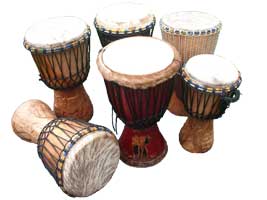
Djembes
These hand drums are prevalent across West Africa, and owe their origin to the Malinke (or Mandeng) people of the empire of
Mali. This covered parts of the present-day countries of Mali, Guinea, Burkina Faso, Ivory Coast, Sierra Leone, Liberia,
Gambia and Senegal.
The djembe has proved to be the most popular drum in drum circles, primarily due to its size (it is very portable) coupled with a wide range of sounds and distinct tones.
Dunduns (also dununs, doundouns or duns)
The origins of the dunduns are closely related to that of the djembe. Consequently, the djembe and
dundun are usually played in combination with each other, with the dunduns providing the bass
component for the rhythms.
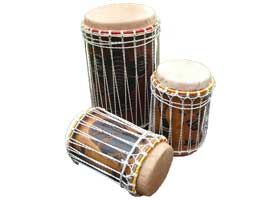
There are three drums in a set of dunduns, the largest and deepest is the dundunba, the next largest is the sangban and the smallest is the kenkeni. The dunduns are stick drums and can be played together by just one player, or played individually along with a bell (which is usually tied to the drum).
Sabars
Sabar is most closely associated with the tribes in Northern Senegal. Wolof is often used to describe the ethnic origin,
but Wolof is really the language, not the ethnic origin. Sabar can be found all over Senegal, although in the South of
Senegal (Casamance), Serouba is more prevalent and is a close cousin of sabar, if a little less loud and more melodic (more
singing accompaniment). Sabar is also popular in The Gambia.
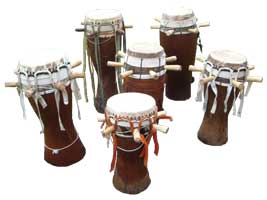
There are a number of different drums that make up the sabar ensemble. Pictured are the nder, chol, talmbat, mbung mbung and tungune. Each of these drums is used to play a different part in an overall sabar rhythm and they are played with stick and hand.